
PSS returns to The White Horse

Event report by Steve McLaren.
On Saturday 3rd August, after a two year break with cancellations, the PSSA once again met up at the Westbury White Horse site in Wiltshire. Although planned as a possible 2-day event, it was clear from the forecasts available before the weekend that flying at this site, which needs a wind from West through to North, would only be possible on the Saturday. The wind was forecast to be solid Westerly on Saturday but moving Southwest on Sunday.
I hadn’t visited this site before and as I drove up the hill out of Bratton village along increasingly narrow lanes, I started to worry about whether there would be enough parking space at the top. But when I reached the top, the vista opened out onto a wide grassy plateau with a huge car park cut into the chalk. I spotted a few familiar cars down the far end, and navigated my way around the bumps, ruts and pot-holes to join them.
It wasn’t the busiest of PSSA events, with just 5 regular PSSA members attending, but we were joined by 2 local flyers who shared our passion for PSS. The wind on Saturday maintained a true West at a pretty steady strength for the whole day. It was measured at various times during the day in a range from 15mph to 22mph on the edge of the slope.
When I first saw the slope I was a little concerned. When compared to the slopes we encounter at most of our other events, it seemed a little narrow! Standing at the launch point in the centre of the slope I estimated that the slope was about 100 yards wide. 50 yards to the left, the slope turned through 90 degrees and ran away from me into the distance. 50 yards to the right, the ground sloped away to the plain below as the slope turned though 90 degrees again and ran away behind me. In fact the Westerly facing slope was really just a short kink in a long Northerly facing slope! I was wondering whether it would support the long side to side passes which seem to be the default flight pattern for most PSS flyers (or is that just me?).
The centre of the slope was no more than about 200 yards from the car park, but there were two ‘kissing gates’ which needed to be negotiated on the way. The main path from the car park drops down a few metres from the level of the upper plateau and runs across the length of the slope just above the famous white horse, after which the site is named, and which is more ‘concreted’ than ‘carved’ into the hillside. There is a second path running along the true peak or edge of the slope about 3 or 4 metres further back and higher up. We used the lower path as the launch point, and then scrambled up to the top path at the end of each flight to get a good view of the extensive landing area, which was covered with nice soft long grass.
The reason that we couldn’t just launch from the upper path, was that the White Horse itself, and the whole of the hill top plateau, is something of a local tourist attraction. And we were there on a very nice sunny day in the middle of summer. There was a steady stream of ‘public’ along the lower path all day, and so this was the only safe way to operate. In fact, I have never spoken to so many people at a PSSA event before. Our models in the ‘pits’ were visible to anyone walking along the lower path, and we got a lot of interest from all sorts of people.
Anyway, before I could get too concerned, the local flyers Phil Huddleston and Andy were rigged, and in the air, and soon showing us how to make the best of this slope. Martin Gay set out the ’rules’ for the day in a quick safety briefing, and it was time to get stuck in!
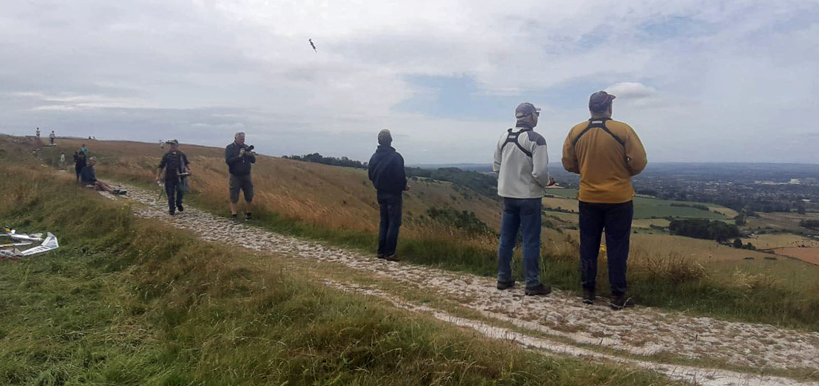
Once in the air, the slope seemed to provide good lift over a much wider band than I was expecting. It is a steep slope and so provided impressive lift for the relatively modest wind speed – most of the time! After a cool start, it was building into a very warm day. Occasionally we ran into the same phenomenon we often experience on inland slopes where the passing patches of ‘thermals’ and ‘sink’ seem to interact with the natural slope lift in such a way that the lift sometimes seemed to disappear, even though there was no apparent change in wind strength. As with many inland slopes, there was also a bit of turbulence here and there, some of it possibly triggered by a line of trees which runs along the very bottom of the slope.
Most of us ‘visitors’ started off by flying small and well-tried models whilst we were trying to get the feel of the slope, and master the conditions. In my case I resorted to my 2014 Mass Build Jet Provost – getting a bit old and tatty now, but perfect for the testing any new slope. But gradually we became a bit more ambitious and at the end of a long day, a good range of model had been flown (even if a few stayed firmly in the boots of our cars to appear on another day, and on another slope, which we maybe felt more comfortable with!)
Martin Pope flew at least 4 of his PSS fleet, including the Tucano, FW190, Spitfire and L39 Albatross – all these models were well suited for the conditions, and Martin had many flights during the day.
Martin Gay spent some time trying to fly his venerable old MiG-15 as low as possible over the white horse to create a bit of an unusual photo opportunity.
Martin Gay and Gordon Studley also flew their U2 in the blue camouflage scheme, and the little foam FMS Alphajet.
The two local flyers Phil and Andy treated us to a bit of formation flying with an almost matching pair of A-10 models. These were both so well camouflaged in green that when flying across the countryside below, my camera seemed unable to focus on them most of the time. Watching their flying, it was clear that these guys knew this slope well, and had the confidence to fly close in to the slope, maintaining the momentum of their models, and resulting in very smooth passes.
Al Gorham flew the largest model of the day – his old Handley Page Halifax, which has starred in a few recent PSS events. Again this seemed to be a favourite with the public (although many of them were heard mistaking it for a Lancaster!). Al made several flights with the Halifax during the day and despite almost getting caught out by the disappearing lift at one point, the model finished the day in pristine condition.
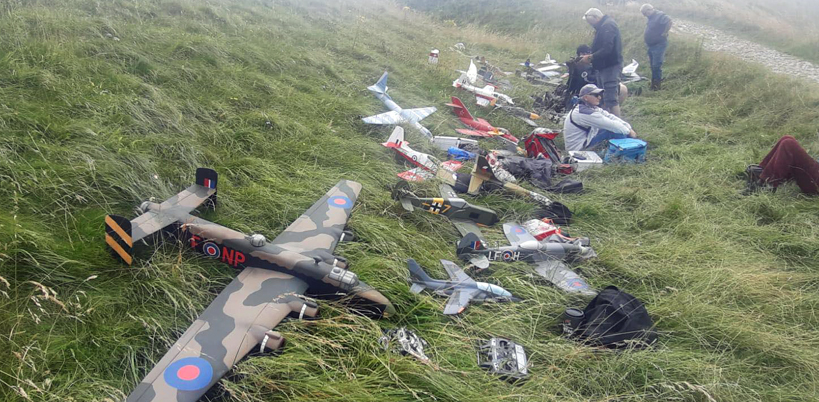
Martin Gay and Al Gorham had a few sessions with the little Alpha Jets, which coped with the conditions very well, and seemed to impress the spectators too.
Local flyer Andy brought along one of the mass build Hurricanes originally built by Brian Boucher. Although it initially flew well, it did get caught out by the disappearing lift, but he successfully bailed into the long grass on the north slope. After that, no more of the heavier models made an appearance!
Local flyer Phil flew a very nice small Sea Vixen (if we trust Al Gorham’s encyclopaedic knowledge of all things aeronautical, it is believed to be from a free magazine plan of the 1990s). The model is somewhat ‘simplified’ with very clean lines, and thin tail booms, which allowed it to maintain some good speed and fly very convincingly. Phil also flew a very nice example of a Hawk from the old PJ models kit which not only flew beautifully, but also shone beautifully in the late afternoon sunshine.
By about 5:30 we were starting to have to stare into the gradually lowering sun, and the models were becoming just silhouettes. At that point, even though the wind was still blowing well, and the lift was still excellent. we decided we had all had enough flying for one day, and we were ready for a beer!
A set of photos taken at this event by Steve McLaren can be viewed in his Flickr album HERE.
Our next event sees us travel to the Bwlch in South Wales to fly the inland slopes around Treorchy as guests of the SWSA – we’ll report from there again once we’ve run the event 17/18th August.