
PSS Light Rules
The following text has been compiled by Steve Griffiths and Andy Blackburn - a result of discussion between Steve, Andy and other PSS modellers who have agreed the rules for a new concept in PSS modelling!
Concept Overview
PSS Light is an innovative competition format enabling meetings to be conducted in lift too light for “normal” PSS. Flying is a duration task, with bonuses for manoeuvres, marks from which are combined with those from a simple static judging process to give a final score for each model. Scoring puts the emphasis on flight, and the numerical results bring fairness and precision to the judging process, making the currently prevalent method of judging by participant voting inapplicable.
The draft rules define the simple flight and static scoring systems, and are formulated to limit judging workload to less than three minutes per model. They introduce a handicapping system to equalise the different efficiencies of models of all sizes and configurations, enabling, for example, a Starfighter to compete on even terms with a U-2. Supporting documentation will only rarely be needed.
PSS Light does not replace the usual meetings, but provides a fallback option for when these are not possible. Many existing models will be competitive, although some advantage may be gained by the use of models designed for light lift, with the added benefit that these will also be suitable for general use even on moderate slopes.
The Steve Griffiths/Andy Conway BAe Hawk design has
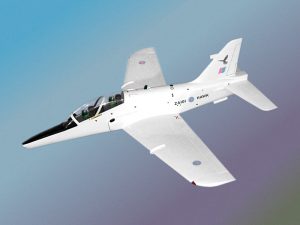
BAE Hawk by Steve Griffith
been well proven to fly in light lift conditions, if built accordingly.Models like this, flown successfully at events when other PSS models remain grounded due to the conditions have invoked the development of 'PSS Light'
PSS Light - Guidance Notes for Judges and Competitors
Measurements
Although the competitor is required to measure the span and length of his aircraft and calculate its group (1, 2 or 3 ), the Competition Director (CD) is entitled to check the accuracy of (scrutineer) any of the entries before prizes are awarded, and may choose to re-classify or exclude any obviously fraudulent entries. For scrutineering purposes, an accuracy +/- 0.5” or +/- 1 cm is recommended for the span and length measurements.
Static Judging
General
Most of the static judging guide is concerned with general outline and colour scheme. No account should be taken of larger-than-scale control surfaces, simplified control surfaces or strip ailerons, and control horns and visible Rx aerials should also be ignored.
The absence of aerials, projecting lights, etc. (especially on the undersurfaces) which are liable to breakage should not be penalised, however prominent they might be on the full-size aircraft.
Deterioration of surface finish, especially on the undersides, through wear and tear should be expected as models age; these are, after all, slope models, and subject to landing on unprepared and often very rough surfaces. Judges should overlook any such effects, and as far as possible assess the models as they imagine they would have been when new.
Models are judged in normal flight configuration; any non-essential items that the builder may have felt fit to produce (opening canopies, lowered undercarriages, etc., should be ignored, and neither be given marks nor penalised).
Suspicious Models
If a competitor submits an unlikely-looking model and fails to provide adequate documentation to substantiate a claim that it (or its colour scheme) is not a gross deviation from scale, the lowest static score in the relevant static sections should be awarded. Judges should be expected to be unfamiliar with rare or little-known aircraft, and competitors entering models of these would be well-advised to bring documentation as a precaution against their authenticity being questioned; in most cases, a good colour picture should suffice.
Deviations from Scale
A Minor Deviation is a deviation that is small enough to be not readily distinguishable from the scale outline without close scrutiny or reference to scale documentation. If an observer were unsure whether there has been any deviation, the model would qualify for this group. Stewart Redfern's Supermarine Attacker and Spiteful would fit into this group.
An Obvious Deviation is a noticeable deviation which has nevertheless been executed in such a way that it does not seriously detract from scale appearance. If an observer thinks there is a deviation but has to ask how big the deviation is, or if the model has visible covered stringers to represent a sheet metal or plywood surface, the model would qualify for this assessment. The Griffiths/Conway Hawk and the Balsacraft Sea Fury kit are good examples, as is the Modeltech P-51 kit.
A Gross Deviation is a significant deviation that adversely affects the appearance of the model as a whole. Adding significantly to the span without a corresponding increase in wing chord would change the shape of the wing, severely compromising the scale appearance and would qualify for this classification, as would a wing that was so much larger than the real thing that it overpowered the rest of the model. The AMD Skyhawk would fit into this group.
Character
Character is defined as "a collection of those characteristics which define the essence of the subject, omission of which will compromise the appearance of the model". For example, the thickness of the Hurricane wing, the shape and dihedral of the Spitfire's wing, the bulk of the P-47's fuselage, the complicated leading-edge geometry of the Vulcan's wing; correct execution of these features will help convince an observer that the model is completely scale even if other areas have been modified.
Models with transparent canopies, etc, and which do not bear visible crew members, should have their marks for character reduced by a one or two points. Models on which transparencies are represented by solid structures, perhaps because of complexity, number of transparencies, etc. should not be penalised unduly; they should be scored similarly if the representation is done well, and whatever is appropriate if done poorly.
The continuous range of points available for this assessment provides the judge with a means of ranking the models, if he so chooses, and helps to vary the static marks, thereby giving more differentiation in the final scoring.
Colour and Markings
Major markings are defined as national insignia, code letters, and personal markings. As this is strictly stand-off scale, the presence or absence of small markings (e.g. stencils, etc) should generally be ignored.
General Hue is defined as an approximately correct colour (e.g. pale grey) that does not necessarily have to match the exact shade of the real aircraft. For instance, using pale grey iron-on film instead of Medium Sea Grey (FS36270) paint is probably acceptable, but using light blue instead of dark blue for WW2 RAF roundels probably isn't.
Detailing should be at a level appropriate to the scale of the model, and judgement made as to whether the details that are visible should be so from the judging distance at that scale. In general, the larger the scale of the model, the more detail should be present to achieve the same score as models at a smaller scale. Panel lines, cockpit detail, and small stencilled markings are obvious cases for attention. The presence of panel lines that are visible and obvious on the real aircraft (e.g. Hurricane ammunition hatches) will fall into this group, although entrants are cautioned that adding all the panel lines may well have the opposite effect to that intended - depending on how they are done. In some cases, it may be better to leave the panel lines off altogether. Panel lines are generally only visible as aggregations of dirt, and are neither hard nor broad lines. Cockpit detail visible in side elevation (seats, gun-sights, coamings, HUDs, etc.) should be considered in judging, but detail hidden below the cockpit line should not. Where they should be expected to be visible (e.g. on larger models), small stencilled markings may be represented adequately by impressionistic, rather than accurate, reproduction. Good guidance as to the visibility of marks can be gained by reference to photographs in which the aircraft appears at a similar size.
Flight Scoring
Bonuses
Swept Wing / Delta / Drag Bonus
The CD decides what is and what is not a Significantly Swept Wing on the day. As a guide, a sweep angle of around 25-30 degrees should be considered as a minimum necessary for a model to qualify. Aircraft such as the Hunter, F-86, Victor would normally be considered to fall into this category, but aircraft such as the Fouga Magister, BAe Hawk and Nimrod would not.
All delta-winged aircraft attract the same bonus, as do models which carry drag-producing items such as engine nacelles (other than those contained within the wing or fuselage, e.g. D.H Comet, Hunter, Tornado), struts, fixed undercarriage, etc. This bonus is awarded once only to a given model, regardless of whatever combination of these items it displays.
Spot Landing
A 10-metre tape or string pinned to a well-marked landing target is easily employed to determine whether a model qualifies for this bonus; the measurement is made when the model has come to rest. In order to prevent “tent-pegging” models into the landing area to score this bonus, they must remain capable of immediate flight without intervention to repair or replace components, and if in doubt, the CD may request the model to be flown in order to prove this. If a model is damaged accidentally in a “sensible” landing, or if, for example, the wing is skewed as a result of a tip being caught, this rule may be may be ignored or adjusted at the CD’s discretion.
Manoeuvres
If a model completes any one of the nominated manoeuvres during the period of timed flight, the score from its timed flight is doubled. Models which are capable of performing manoeuvres and still achieving a good flight are obviously better equipped for the air than those which are not, and this bonus recognises that capability. Any number of manoeuvres may be performed, but only one of each will attract bonus points; e.g. three loops score the same total as one.
No judgement is to be made of the precision or accuracy of manoeuvres. For example, a loop need not be circular, nor have exit point at the same height as entry. It need only be substantially in the vertical plane and with the wings of the model more or less level, and then provided the model “goes over the top”, it is counted.
Timed Flight
Models score one point per second of timed flight up to the maximum time set by the CD for the round. Timing is to the nearest complete second, and begins at the moment the model leaves the launcher’s hand (unless a handicap applies - see below). Timing ends when the model contacts the ground or any item which is itself in contact with the ground (even if it continues to fly thereafter), or vanishes from the timekeeper’s view (e.g. into cloud, behind a hill, etc), or of course if the maximum flight time is achieved. Only complete seconds are counted, permitting timing to be done using an ordinary wristwatch, although more easily with a stopwatch. Fractions of seconds are discounted to remove error associated with timekeepers’ varying reaction times.
Handicaps
Handicaps are expressed as percentages of the maximum timed flight target time, and are applied to models in the middle and upper size bands in each group. They define additional flight times which models in these bands must complete before timing of their flight begins, and are 1 minute for the middle band, and 2 minutes for the upper. Hence, a middle-band model must fly for 60 seconds from launch before the timekeeper starts to record flight time for scoring purposes. For the upper band, this pre-timing flight interval would be 120 seconds. The intention of the handicap is to allow smaller models to compete equitably who bigger ones, whose increased efficiency would otherwise lend them an unfair advantage.
Tasks
The CD defines the maximum timed flight to be applicable in each round of flying, and the maximum number of models to be flown simultaneously. More than one flying slot may be needed to complete each round, and whether flown as formal slots or on a basis of availability of frequency peg and timekeeper is at the CD’s discretion. Each pilot will need a timekeeper, and may elect to have his model launched; thus there can be at most half as many models flying as there are pilots and helpers, and possibly less if self-launching is not common. It is expected that pilots will act as timekeepers for other pilots, and conduct themselves in an honest and sporting manner in this capacity.
The pilot will measure the model's span and length before the competition, calculating the span/length ratio and determining the model's group (1, 2 or 3). This information is supplied to the CD when the model is entered into the competition, and is entered by the pilot on the model's score sheet (see below).
The judge will need a tape measure (in case he decides to check any of the competitor's supplied measurements) and a pocket calculator for adding up and normalising the final scores. He checks the heading boxes on flight scoresheets, verifying that any applicable span handicap and sweep/delta/drag bonus points are correctly marked. The flight scoresheet for each model is then carried by the model’s pilot, and handed to his timekeeper on each flight for flight scoring.
The timekeeper (who may be a different person on each flight) is responsible for timing any handicap flight time and the timed flight, for recording the completion of manoeuvres, for calculating double the flight time if any manoeuvre is completed, and for summing the points scored in the round by the model he is timing.
On completion of flying, flight scores are transferred to the aggregate scoresheet by the judge, who then calculates the normalised scored for each group, as follows;
The best flying score in each group is reduced to a value of 200, and all other scores in that group are reduced in proportion. For example, if the top score in the group is 320, this becomes 200 by multiplying by a factor of 200/320, or 0.625. Another model, with a score of 300, would then get a normalised score of 300 x 0.625, i.e. 187.5. If in another group the top score was 400, this too would be reduced to 200, and scores for other models in that group multiplied by 200/400, i.e. 0.5.
The addition of static scores and normalised flight scores for each model determines that model’s final score, and placings can be allocated on the basis of the highest score being the winner. Scores can be ranked easily for sub-competitions if required; e.g. the winner of each group, the winning model of jet- or propellor-powered aircraft, etc.
Proposed PSS Light Judging System - Draft G3
- Eligibility
0.1. PSS Light is open to any model of a man-carrying powered aeroplane.
0.2. Any restrictions on entry to a specific competition are a matter for the CD, but in principle there is no reason why a motor glider should not be able to compete fairly with other more normal PSS models.
1. Grouping
1.1. Models will be classified into one of three groups to enable disparate prototypes to compete on a reasonably fair and even basis. The pilot will classify his model(s) using the following procedure.
1.1.1. The wingspan and length of the model is measured and rounded to the next ¼"; the wingspan measurement must include tip tanks, finlets, rockets, etc and the fuselage measurement must exclude probes, antennas, etc.
1.1.2. The wingspan is divided by the length to produce a span/length ratio
1.1.3. The model is allocated to a group as follows:
Group 1 if span/length ratio <= 0.95
Group 2 if 0.95 > span/length ratio <= 1.43
Group 3 if span/length ratio > 1.43
1.2. The pilot will supply the span, length, span/length ratio and Group for each model entered. The CD can choose to measure any or all of the entered models prior to awarding prizes, and is entitled to exclude or recalculate the score of any model that is found to be incorrectly classified.
2. Flight Score
2.1. There will be a number of flight rounds (typically two) during which models will be flown to earn a flight score. The number of rounds is determined by the CD, dependent on local conditions.
2.2. The score from each round will be based on the duration of flight with bonuses for aircraft configuration and manoeuvres completed, and handicaps to take into account the improved efficiency of larger models.
2.3. The timed part of the flight score will be subject to a maximum value for each flight round. The maximum value is dependent on prevailing conditions and is determined by the CD, but 300 seconds (5 minutes) is suggested.
2.4. The model will be launched by hand. No other launching method is permitted, though there are no restrictions on launch technique.
2.5. The flight time for each round will be calculated as follows;
2.5.1. In order to enable models of all sizes to compete with larger models on a fair and equitable basis, they are placed in one of three size bands in each group, based on the wingspan measured as specified in section 1.1.1:
| Group | Size Band | ||
| A | Below 28" | 28" to 38" | Over 38" |
| B | Below 36" | 36" to 48" | Over 48" |
| C | Below 45" | 55" to 85" | Over 85" |
2.5.1.1. If the model is in the smallest size band, timing begins at launch.
2.5.1.2. If the model is in the middle size band, an additional period of flight equal to 1 minute must be completed before timing begins. With the suggested 5 minute maximum time, models in this size band must fly for at least 6 minutes to gain the maximum 5 minute flight time.
2.5.1.3. If the model is in the largest size band, an additional period of flight equal to 2 minutes must be completed before timing begins. With the suggested 5 minute maximum time, models in this size band must fly for at least 7 minutes to gain the maximum 5 minute flight time.
2.5.2 The following manoeuvre bonuses will be given provided that the manoeuvre being marked is completed within the period of timed flight, and is announced by the pilot before it is begun. Note that no judgement of the precision or accuracy of these manoeuvres should be made.
2.5.2.1 If at least one loop is performed, 15 seconds.
2.5.2.2 If at least one roll is performed, 30 seconds.
2.5.2.3 If at least one stall turn is performed, 15 seconds.
2.5.2.4 If at least one inverted circuit is performed, 45 seconds.
2.5.3 If the model has a significantly swept wing, a delta wing, struts, fixed undercarriage, engine nacelles outboard of the wing root, or any combination thereof, 30 seconds is added.
2.5.4 If the model comes to rest with any part of its structure within 10m of a spot defined by the CD, a further bonus of 30 seconds is awarded. This is only applicable if the model is flyable immediately without adjustment or repair; the CD may request an immediate flight to prove that this is the case.
2.5.5 The final flight score for each model for each round is calculated as follows;
2.5.5.1 One point is awarded for each complete second of timed flight up to the maximum.
2.5.5.2 If any of the manoeuvres defined in sections 2.5.2.1 to 2.5.2.4 have been scored, the timed flight points are doubled.
2.5.5.3 The flight score for the round is obtained by adding any bonuses which have been awarded to the timed flight points.
2.5.5.4 When all the flight scores have been returned, the total flight scores for all the models in a group are normalised so that the highest-scoring model in each group gets 200 points and models with a lower score get a proportion (calculated as [individual flight score / best flight score]) of the 200 point maximum.
3. Static Score
3.1 Each model will receive a static score generated by reference to the following table.
| Component | Static Points | Max
Score |
|||
| Outline | Scale outline or minor deviation. | Moderate scale deviation. | Major scale deviation. | Gross scale deviation. | 50 |
| +50 | +40 | +15 | +0 | ||
| Colour and Markings | All major markings present and correctly placed, colour rendition is correct in general hue. | Some minor markings missing or simplified, colours incorrect in general hue. | Major markings missing or simplified, or gross deviation in some colours. | Incorrect or missing colour scheme and markings. | 25 |
| +25 | +20 | +10 | +0 | ||
| Character | Model has all the important features of the full-size and looks like a miniature replica. | Model looks nothing like the original | 25 | ||
| +25 to +5 | +0 | ||||
| Maximum score | 100 | ||||
3.3. The model should be marked in such a way that due allowance is made for wear and tear, and the fact that the model operates in a less-than-benign environment.
3.3.1. Models are to be judged in normal flight configuration.
3.3.2. Vulnerable details liable to breakage may be omitted without penalty.
3.3.3. Any cockpit detail visible below the cockpit sill (dials, joystick, etc.) should not be marked.
3.3.4. Any cockpit detail visible above the cockpit sill (e.g. ejector seat, gunsight, etc.) should be marked.
3.3.5. Absence of a normally-visible member of the crew (e.g. pilot) should be regarded as a moderate deviation at worst.
3.3.6. The representation of a transparent area (e.g. canopy, windows) by paint or film should be regarded as a moderate deviation at worst.
3.2 Proof of Scale
3.2.1. Under normal conditions no proof of scale will be required, as the contest director will rely on his own knowledge of the type. However, if the colour scheme is sufficiently unusual to raise questions about its authenticity or if the organiser is not familiar with the prototype, the entrant may provide a small amount of documentation (e.g. photos, colour profile, etc.) to be viewed before the static judging has taken place. Note that the documentation should not be used for direct comparison as other models may not have documentation and all should be treated equally.
3.2.2. Documentation should not be used for direct comparison with the model as other models may not have documentation and all should be treated equally.
4. Final Score
4.1. Models will receive a final score that is the sum of their normalised flight score (maximum 200 points) and their static score (maximum 100 points).
4.2. In the case of a tie, the following tie break procedures should be applied, in order of precedence;
4.2.1 Best flight score wins
4.2.2 Best static character bonus wins
4.3. If models are still tied after applying the procedures defined in paragraph 4.2, the CD should nominate a flyoff task - typically the shortest time to complete a specific set of manoeuvres - that all tied models should fly simultaneously.
4.4. Although the determination of winners for the purposes of prize-giving is a matter for the CD, the system has been designed so that the final scores of all the models can be compared on a reasonably equal basis, irrespective of their group classification.
5. Arbitration
The decision of the CD is final.
6. Abbreviations
CD - Contest Director
7. Definitions:
7.1. Loop. A loop is when the model pulls up from normal flight through inverted and back to normal. The manoeuvre is not judged on aesthetic quality (i.e. the loop does not have to follow a circular path), but must be executed substantially in the vertical plane with the model's wings remaining substantially level.
7.2. Inverted Circuit. A circuit begins when the model is pointing directly away from the slope, and is completed when it again points in that direction after turning through a full circle. The manoeuvre is not judged on aesthetic quality (i.e. the circuit does not have to follow a circular path, nor start and end in the same position), but must be executed substantially in the horizontal plane and with the model inverted. The angle of bank in the circuit should generally not exceed 45 degrees
7.3. Stall Turn. A stall turn begins with the model in level flight (however briefly), from which it pulls up vertically and, when its flying speed is almost zero, yaws through 180 degrees to point vertically downwards, then pulling out into level flight again on the opposite heading to that from which it began. The manoeuvre is not judged on aesthetic quality, but the aircraft's flight path and attitude must be substantially as described above, and the radius of the yawed turn must not exceed approximately one wingspan.
7.4. Roll. A roll is a rotation of 360 degrees about the model’s longitudinal axis, starting from upright and returning to that orientation. The rotation need not be axial, though the aircraft’s heading and altitude should remain reasonably constant throughout the manoeuvre. Rolls which are not attempted in approximately the horizontal plane are not counted.
Thank-you for your interest in the PSSA, if you have any questions regarding our Association or PSS in general please contact us;