
The long awaited return of Westerly winds in North Wales!

Phil Cooke reports from a blustery Llandudno…
July 1st / 2nd saw us meet at the Great Orme in Llandudno for our third PSSA Fly for Fun event of the 2023 season – we enjoyed a large turnout of models and pilots with the Westerly winds finally returning to the UK shores following an unprecedented period of Easterlies! The winds placed us back on our most favoured ‘Tank Track’ site which makes running our group events so much easier than the pier site with proximity to the car park.
The XC-Weather forecast for town was centred around 25mph W and this of course would mean even higher winds on top of the hill, allowing pilots to bring out their heavier loaded models for a good ‘high octane’ airing! Everything was set for a big event and with numbers and safety in mind we briefed a couple of changes to our usual Fly-for-Fun format. We agreed to introduce a more formal flight-line marshal, prominent with their Hi-Vis PSSA vest – who would manage the operation of the dedicated launch area, the pilots box and the landing zone, ensuring good communication between pilots and safe release/recovery of models throughout the day. We also agreed to limit the number of aircraft in the sky at any one time to 6, giving more space for pilots to operate in on the slope. I’m glad to say the marshal idea was well received and proved effective – there was never a shortage of pilots willing to do their bit on the rota and I received positive feedback from those flying. Despite our efforts on numbers, I’m afraid we still suffered one mid-air incident each day resulting in the loss or damage of 4 PSS models. Both of these events occurred when we hadn’t even achieved the 6 aircraft limit – a result I think of the models flying significantly faster than they often do in the high energy conditions.
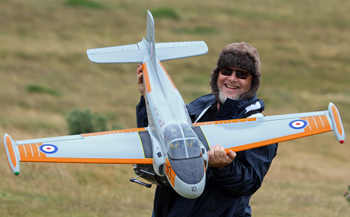 As expected there was a huge collection of models on show over the two days, some old, many new, with what I considered a surprising number of maiden flights achieved in the ‘top-end’ wind conditions. Chris Barlow flew his superb Jet Provost 150 for the first time, beautifully finished in glass and 2-pack paints to represent XS186 from the RAF College of Air Warfare at RAF Manby, circa 1966 – a rare, short lived scheme in grey and day-glo orange which we haven’t seen modelled before. If my sums are correct this is the sixth JP 150 to be built and flown from the batch of 12 short kits we had commissioned via SLEC, and like all the others Chris’s model performed flawlessly from launch – I must get mine finished this season to make it seven!
Rich Henderson had joined us and quickly set about test flying his brand new Mikoyan-Gurevich MiG-15 built from his own hand drawn plans and finished in a striking weathered silver and red scheme of the Chinese Airforce. The model is of conventional balsa construction and looked to be of similar scale to the G&M models F-86 Sabre from our most recent Mass Build. The MiG was launched from the top shelf and went away very smoothly, it was immediately evident this was going to be a winner and Rich enjoyed a nimble 15 minute maiden flight in great conditions before bringing the little MiG ‘Red 07’ safely home into the landing zone. (see title image)
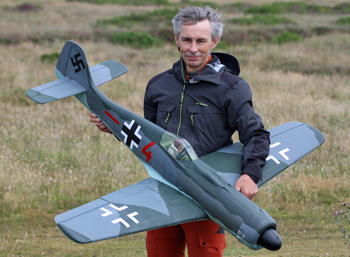 John Hey successfully test flew a new Focke-Wulf FW-190 which he had picked up at a swap meet and converted to PSS. His maiden flight went very well, just reward for John’s efforts who apparently had stayed up all night prior in a last ditch attempt to complete the model ready for flight at this event. Dave Gilder test flew his Panavia Tornado having brought it to previous events over the past couple of years but not yet flown, one of three Tornados flown at this event. Finished in the ‘One Million Flight hours’ RAF commemorative scheme, Dave’s GR4 version of the Tornado is built from a 150% scale version of the Andy Conway plan and at this scale the model has real presence! Dave’s test flight proved the CoG was a little too far forward even in the high lift conditions and having reached the limits of trim alone a controlled landing was achieved on the lower ledge we have available to us on the Westerly slope. Dave will take this learning now and will no doubt have the Tornado better balanced and trimmed ready for our next outing later this month.
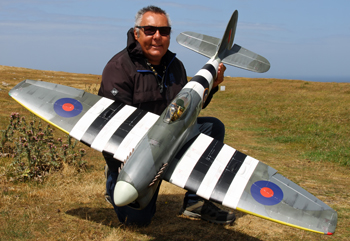 Steve Kemp had travelled with a car brimming with models – 11 I think in total – ALL of which he flew at some point over the weekend! The pick of these models has to be his new Hawker Tempest which was test flown successfully at this event. At 61.5” span Steve has built this 1/8th scale model from the Brian Taylor power plans and finished it superbly with waterslides and weathering all applied under a satin lacquer finish. It had been brought to prior events but Steve had been reluctant to test fly in the conditions due to the 10lb AUW of the model. There was no such fears this weekend with the conditions being so ideal – Andy Meade provided the launch a little below the top ledge and out of the compression zone and the model soared away effortlessly. Steve settled quickly on the sticks with the model being well behaved, its wing loading gave it some great energy and penetration and it all looked very smooth and controlled. Brilliant to finally see this fantastic model airborne!
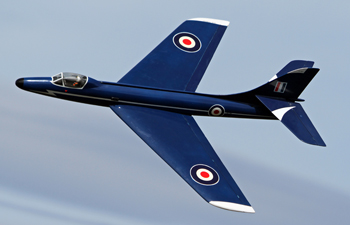 Having covered the brand new models its worthy of note that a couple of true ‘vintage’ PSS models were in action too. It was great to see Simon Cocker once again flying his FMA IA 58 Pucará – originally designed, built and flown by John Hill back in the late eighties. It’s a testament to the models white foam and veneer construction method that the Pucará is still going strong after all these years – and at 10lb AUW and spanning 80” it was cutting a spritely groove in the conditions being ably flown by Simon and Matt Dixon. But amazingly this wasn’t the eldest model in action! Before his launch, John Hey explained to me that his little Hawker Hunter was fast approaching its 40th birthday, having originally been built by his dad from a Radio Modeller slope plan in 1984. Designed by Harold Bull, this model pre-dates the formation of the PSSA (1986) and (we think) even the general term PSS – the magazine report describing it as a ‘Jet Fighter Glider’! Impressive to say the least – John put on a good display with his old Hunter which still looked great in its RAF dark blue scheme with white trim.
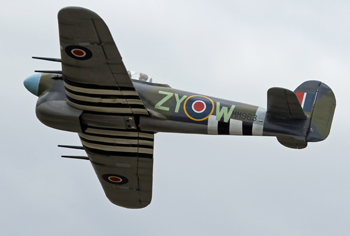 As expected with the conditions so good a lot of the bigger, heavier and lesser flown models were in action throughout the two days. Andy Meade enjoyed some good flight time with his huge Hawker Typhoon, at almost ¼ scale this model cruises along with real presence and is rock solid in flight – very realistic! Bob Jennings successfully flew his O/D BAe Nimrod MRA4, I think now on it’s third flight, having made minor refinements to balance and trim each time out. Simon Cocker and Matt Dixon flew a pair of 108” span Boeing B-52s together as a Strategic Air Command duo, both models built from Simons original plan. Big models like these really draw the attention of the audience, large scale PSS is still such a spectacle even for the well campaigned pilots and spectators! Brilliant stuff!
On Saturday evening we met as a group and 16 of us enjoyed a well earned meal and a few beers at The Queens Head in Glanwydden. Its fair to say there were a few tired, sun and wind burnt faces evident and the meal was probably needed most by all those who were camping locally – a good social as always was enjoyed by all.
All in all this was a great weekends flying, a release for us all in many ways having frustratingly endured light lift conditions at our previous two events. A huge thanks to everyone who travelled and took part. Some photos from the event can be seen HERE and another review of the event by Pete Garsden can be read on the LMMGA website HERE.
Our next PSSA event runs at the end of the month where we return to the Lleyn Peninsula 29th / 30th July. Fingers crossed we get some more ideal conditions and dominant Westerlies! See you there!