
Trying to tame ‘The Wrecker’

Phil Cooke reports in from the Bwlch, South Wales where on 24th July the PSSA flew in challenging conditions at ‘The Wrecker’…
This years SWSA meet at The Bwlch fell hot on the heels of our recent Lleyn MAC visit with us having lost the originally set date to Covid travel limitations in May. That said, following some invaluable help from Steve Houghton, we were very happy to re-establish the South Wales event having missed out completely in our 2020 events calendar.
We met up with local slope guru Joshua May in the Ice-Cream car park before 10am Saturday and with his local knowledge agreed that ‘The Wrecker’ slope would be best suited to the NE winds we had been dealt. Just a short drive from our meeting point we had soon established camp in the car park immediately adjacent to the active slope. With only 6 pilots present, we held a short pilots brief and discussed some of the known difficulties at this site – particularly our proximity to the road just behind the flying site, the complete lack of ‘land out’ options below the launch point and the viscous rotor associated with this slope in the 20mph winds. To aid awareness, we marked the road position with a windsock placed behind the launch point which immediately enabled us to visualise the rotor – unbelievably at times the sock was blowing completely opposed to the ‘true’ direction of the wind at the slope edge – amazing!
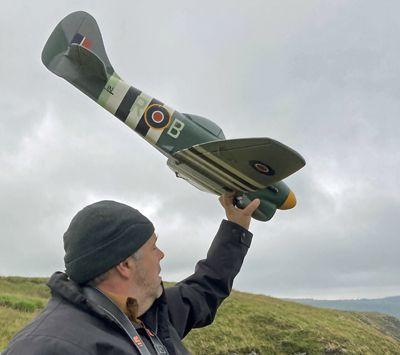 Andy Meade was first off the mark flying his well proven and robust little Hawker Tempest. After a short aerobatic flight (which proved the slope lift to be epic!) he started to gain a feel for the landing approach around the back. As consecutive circuits were gradually lowered in height and all seemed to be ok – he suddenly ably demonstrated the true strength of the rotor – it momentarily throwing the Tempest onto its back just a few metres above the landing zone! Thankfully Andy was flying the right sort of model for this demonstration flight and its nimble response allowed him just enough recovery in roll and pitch to land right side up, but in a manner – partially at least – in the hands of the Gods. Food for thought!
With this learning we agreed as a group to perform all landings on the other side of the road, and that anyone calling ‘landing’ should be safely escorted across the road and up the slope towards ‘Back of Wrecker’ to a landing site beyond the reach of the rotor. This was how we operated for the rest of the day with landings effectively being a two man job for safety. But even with that in place we were not without drama – landing so far behind the launch point meant there was no rotor but also very little headwind into which we could slow the models up. As a result, landings were performed with airspeeds and decent rates much higher than what would be classed ideal – particularly considering the lumpy, tufty grass surface we were dropping our models down into. Catch a wingtip or tailplane on one of these tufts at speed and you can seriously damage a PSS model even when the approach and landing are completely textbook. This risk was apparent all day and frustratingly a number of us ended good flights with various degrees of damage to our models.
My description of the ‘challenging’ landing zone action should not overshadow the superb slope flying we were all enjoying from start to finish throughout the day. The combination of the 20mph NE windspeed and the topography of the 1000ft slope we were stood on top of produced some superb lift and you could fly a huge path left and right and far out from the launch point with complete confidence – it was a real ‘high octane’ kind of slope even with these average windspeeds. Everything would fly – if you were brave enough to risk the model in the landing zone. Naturally this did stop some of the newer models being aired, it didn’t feel quite right to risk certain airframes at this site when there is still so much flying to be enjoyed this season. That’s what I told myself, anyhow, as I sheepishly left my F-86 Sabre hidden in the boot…
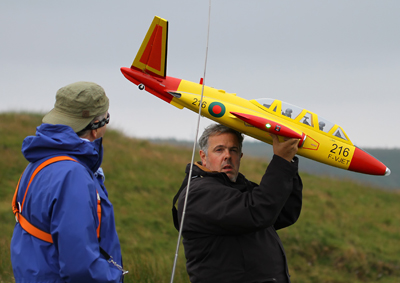 I enjoyed a lengthy flight with my little Top Gun A-4 Skyhawk which always goes best on big lift days – not an overly flown model, oddly it always seems to get a good airing whenever we are at the Bwlch! Still great fun in the right conditions. Jez Billington enjoyed an early flight too with his Fouga Magister, resplendent in it’s bright Bangladeshi Air Force colours and as with a lot of Jez’s models, fitted with those fantastic wingtip and fuselage strobe lights supplied by Flytron! These never fail to impress – even on sunny days – but in the gloomy overcast conditions we were flying in these really did stand out and shone bright! A brilliant addition to any scale model at this sort of scale. Peter Garsden flew his F-86 Sabre modified from the MB plan build with his own fibreglass fuselage. The model seemed to fly very well in the good lift but Peter later reported it feeling a little off-song – and sadly despite a well tailored landing approach and touchdown into the field at the back the leading edge of the Sabres wing suffered some damage after the airframe was abruptly halted by the lumpy, tufty grass. I’m hopeful that Peter will have the model repaired in time for our September Mass Build event!
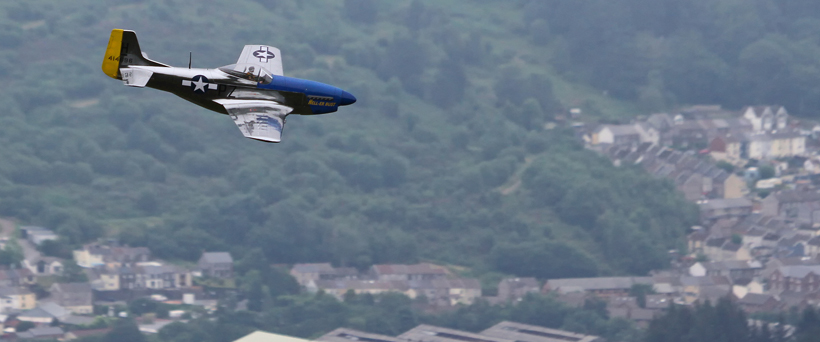 Andy Meade aired his NA P-51D Mustang, originally converted to PSS from the Black Horse ARTF power kit by Matt Jones. This large model excelled in the conditions and looked really good when flown low with its highly mirrored aluminium finish contrasting against the green and brown Welsh landscape below. Mustangs are quite a common site at all our events but not quite like this – the size of this particular ‘Cadillac of the Sky’ produces the illusion of a scale cruise speed and it really looked the part throughout the flight. Unfortunately the lower nose and underside of this model was also damaged on landing but I know Andy will soon have his P-51 flight ready once again.
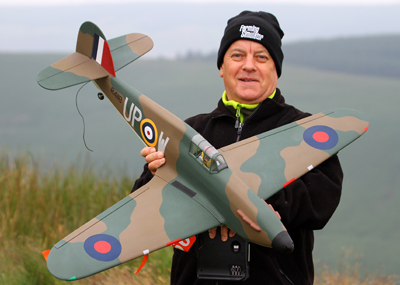 Martin Pope braved a maiden flight with his delightful Hawker Hurricane, converted to PSS from the Cambrian Models power kit and very well finished using Humbrol enamels to represent Hurricane Mk 1 R4118 of the Hurricane Heritage Flight based at Old Warden. With pre-flight checks complete the model climbed away well from launch and once settled in Martin enjoyed a lengthy first flight with his new Battle of Britain Hurricane. During the flight Martin asked for my take on the models set up and offered me the sticks – I could not refuse! I found it was nicely balanced and felt good on the ailerons with a roll rate about right for the type, however the elevator had too much movement and was over powering and in need of some rates and expo – in the set up as being flown you only had to breathe on the elevator to avoid over-control. At the end of the flight Martin made his way over from the flying site to the landing zone at the back, crossing the road with his allocated helping guide. However during this transition Martin got into some difficulty and the model lost some height and flew below the ridge line and from his position, below his line of sight. In the confusion we were not exactly certain where the model ended up and despite a number of man hours being spent looking for it on Saturday afternoon (from both the top and bottom of the hill), sadly the model could not be spotted. The scale of the mountain combined with the uncertainty of the models last seen direction of flight, position and orientation made it feel like an impossible task.
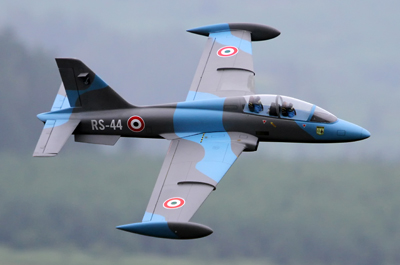 Jez Billington continued to appear at the pits with new models, rigging both his Hawker Sea Hawk and a new Aermacchi MB-339 which he had recently acquired on the second hand market. Currently finished in a rather obscure Italian airforce scheme, Jez explained he intended to test fly the model to prove its characteristics before refining it to his usual build and finish standards. Of course coming from the Island Models stable the models flight capability was never in doubt and Jez enjoyed a really good session with the new Aermacchi – he was immediately at ease with the model and flying it like he’d owned it for years – in fact I heard him comment that it flew better than his other example of the type! I helped marshal Jez safely back to the landing zone and witnessed him dropping the model very nicely into the bumpy grass strip without any damage! A huge relief after a couple of hours flying where as a collective we’d suffered a lot of unfair attrition!
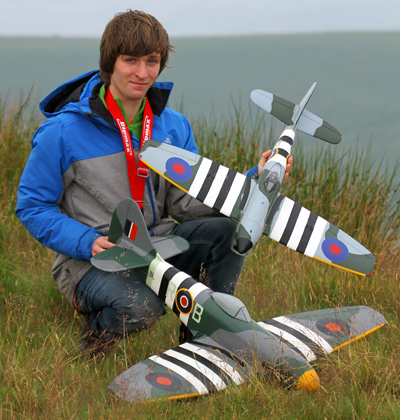
A little later in the afternoon there was an excellent fast paced slot filled with a pair of small scale Hawker Tempests flown by Josh May and Andy Meade.
Josh’s model had been built for PSS from the little Hobbyking EP kit, all foam in construction, considering its size and weight (just 32” span and way below 2lb AUW I think) the model had a great performance, in every sense a little rocket ship! Josh was clearly enjoying himself in the abundant lift and at times working some neat formation flying with Andy Meade flying his slightly bigger, heavier and conventionally built example of the same type.
Both were cutting a groove for some time and performing some pretty big vertical half pipe manoeuvres with the speed and energy they were both carrying – Excellent stuff!
As the afternoon wore on there was a lovely flight performed by Andy Meade and his newly acquired Hawker Typhoon, a model we have seen many times before at the Bwlch – initially flown by Steve Houghton and then more recently by Phil May, both local SWSA flyers. Andy’s obsession with WWII Hawker designs now sees him own this airframe too, and considering this was his first flight with this (admittedly well proven) model, it was testament to both his flying and the model as to how well and refined it all went. 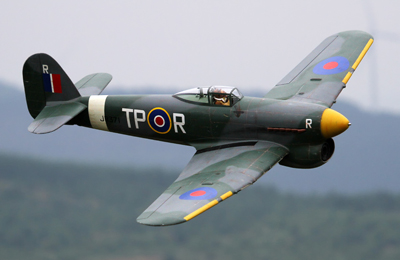 Originally built by John Plumbley for PSS from the Brian Taylor power plans, this model has always turned heads with the quality of build and finish, as with all of John’s stuff it is museum standard. It’s relatively lightly loaded too and this produced a superb flight performance from the slope. Andy was kind enough to let me have a go, the combination of this well refined model all dialled into his new FrSky Transmitter was a great match, I was immediately at home flying it as its characteristics and feel were very much like my trusty old Sea Fury. We must fly them together sometime! Back on the sticks, Andy was enjoying putting the Typhoon through its paces with a series gentle dives and low passes for the camera – very reminiscent of the full-size in the ground attack role. Thankfully another safe landing was performed over the road with one of the very few landings I saw all day which actually slid nicely to a halt as opposed to being suddenly retarded by the aggressive surface of the landing zone.
It had been overcast and threatening rain all day, in fact as it panned out we stayed dry until about 6pm when a little rain came through, and having flown since 10:30am this naturally brought the days activities to an end, some heading for home, a few heading for a well earned pint and a meal at the Bunch of Grapes in Pontypridd.
Sadly, Sundays forecast was poor for us – with high pressure dominating and the resultant windspeeds of only 5mph coming from all directions of the compass. As planned we met at the car park and agreed that (for that hour at least) VR98 was the preferred slope – but there was never enough lift for PSS, just foamies and DLGs. I had no model suited to the calm conditions and decided instead to walk back towards The Wrecker from VR98 with Martin to see if we could utilise the different viewing angle to help us spot his Hurricane, which sadly had spent the night still lost on the mountain. Having replayed in our heads the last known seconds of the witnessed flight, we studied the mountain using binoculars from our new vantage point. 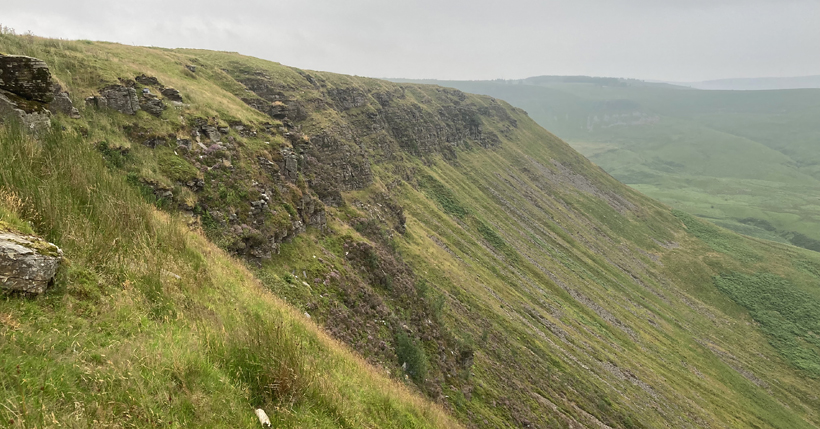 Again the scale of the mountain, its complex surface of scree and vegetation combined with the small scale camouflaged model all made this a task with a low likelihood of winning. But then, after about 45 minutes – SUCCESS!! Through his binoculars Martin spotted what he believed was the underside of his Hurricane wing half way up the hillside, in a position quite different to where we thought the model should have ended up. It was tiny, barely visible really, but just below it was another spec of colour not natural to the hillside – so hard to make out, but clearly a small geometric shape coloured just like the ‘Sky Type S’ underside of an RAF Hurricane. We’d found it! Having walked back to VR98 to relay our good news to the group, Martin and I drove down the road to the base of The Wrecker where – with our new target still visual – we walked and then climbed up the steep slope to the crash site.
It was a great relief to recover the model, although it was badly beaten up having flown into the rock face it will be repaired and it will fly again! So some success and good fortune at least on the Sunday which effectively was a non-flying day!
More photos taken at this event can be viewed HERE.
Many thanks once again to Steve Houghton for helping us establish this Fly-In during a difficult year and also to Joshua and Phil May who helped coordinate our activities over the weekend lending much needed slope guidance. Much appreciated chaps, we look forward to returning to fly with the SWSA once again next season!
Nice write up chief, great to hear that Martin eventually recovered his model…. had me in tears nearly 😉
If it’s any consolation there was far more damage (and tears) at my grandson’s 3rd birthday party 🎉😂