
PSS hampered by High Pressure conditions at the Lleyn!

This won’t be a write up in the usual format – truth be told the amount of PSS flying we achieved over the two days was very limited due to the local conditions. With huge thanks to the LMAC committee we had rescheduled our annual visit to the Lleyn peninsula to 8th/9th August to defer our event beyond the Welsh lockdown period, in an attempt to maintain this prized weekend on our 2020 calendar. That part of the plan all worked well! Attendees willing to make the long journey to the Abersoch area could now stay over on camp sites and in hotels or B&Bs where they needed, shops and bars were open and it was all very much business as usual within the Covid-19 guidelines – Sadly it was the winds which let us down and frustrated us throughout our weekend!
On Saturday the winds were blowing quite nicely at 15-18mph from the North. The Lleyn club recognise 2 sites with a northerly slope, unfortunately the better of the 2 slopes (from a lifting perspective) at Mynydd Mawr down near Aberdaron doesn’t offer a landing zone suitable for our scale balsa models, and parking was also a concern for a group of our size (there were about 15 pilots in attendance on Saturday). So this left us with Mynydd Rhiw, at the West end of Hells Mouth bay, a high peak on the peninsula with its pair of prominent telecoms masts, but a hill with a long, gentle gradient unlike what we were used to at the coastal sites. The topography of the land meant that only the lightest of PSS models could get away safely even though the wind speeds were more than enough for us to enjoy our models had we been on a steeper coastal cliff. As well as the gentle descent and poor lifting vector, the site on top of the hill was also divided with a number of robust dry stone walls which certainly played on the mind during any launch or landing.
As it was, folks made the most of the day flying sports models which could fly ably in the lift as it was glorious weather, warm and sunny – and the view from the top of Rhiw in all directions was stunning. We took the opportunity to take a closer look at some of the new models on site, Andy Meade’s F-100 Super Sabre, Geoff Mortimer’s large scale Hawker Hunter and Dave Gilder’s Tornado GR4 (title image) were just some of the highlights!
Chris Barlow was first to fly PSS with his Ian Benson Vulcan, which performed very well using a mixture of both slope and thermal lift I think. I tried to fly my JP from the same spot Chris was stood at, but I could only muster a couple of passes before I was forced to land, the JP was just not quite thermally enough!! A little later in the day folks began to try to fly from other sites where very localised ridges could be utilised with the smaller models. The best, in my opinion, was the land mass upon which the main telephone mast was built upon. From here my JP would fly, both ridge running very locally to the launch point, or further out beyond the stone wall. Others followed suit and with the right model a number of us enjoyed some prolonged PSS flying from this location. Tim Mackey flew his little foam Vampire and a new NA Harvard which was very nicely detailed with working lights. Steve McLaren flew his Ripmax Mustang, Bob Jennings flew his MiG-3 and Andy Meade had a flight with his BAe Hawk.
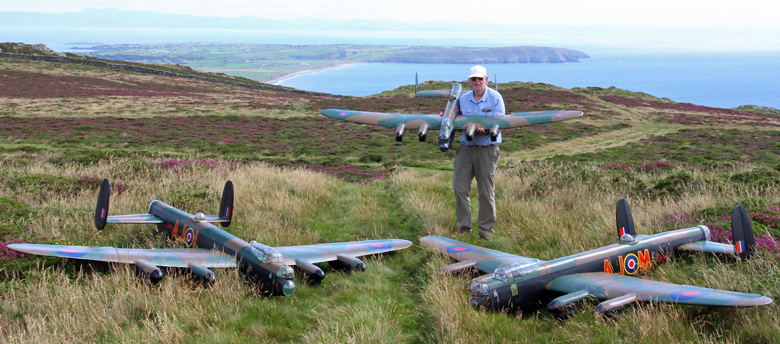
Chris Collis and his 3 Lancasters. 2 of the 3 were flown on Saturday.
Star of the afternoon was a very brave Chris Collis who was keen to test fly his new large scale Lancasters, asking myself and Andy Meade to drop in and programme an Rx each onto our Tx so we could fly all three Lancs together! Andy and I were both a little nervous about this as the slope was far from ideal to test a new model. Chris flew his smaller well proven Lancaster in an attempt to build confidence in the lift. The model flew ok, at this slightly bigger scale it could be flown further out over the valley where I think the lift had a slightly better vector. Chris brought that model back in and we discussed whether or not we should proceed with the bigger ones. In the end we decided to go for it and the 26lb model finally got away on the third attempt (again evidence of the poor lift vector I think as it was tough to launch at the required speed) it floating out over the wall and over the valley into the lift.
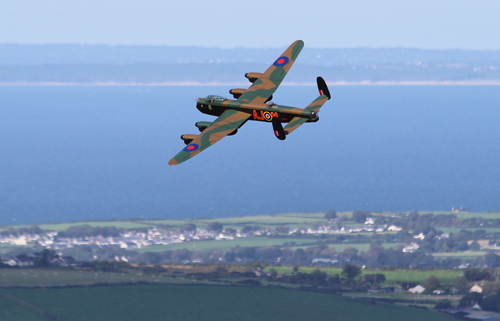
The large scale Lancaster on a hunt for some more warm lifting air!
At the controls, the model felt a little tail heavy to me but was quite controllable, my key focus was trying to find the right balance between an angle of flap needed to improve lift and the amount of elevator trim needed to maintain speed. As the lift bobbled up and down and was constantly variable each pass this trimming game ran throughout the flight, I was kept occupied constantly trading lifting properties with the flap for speed on the elevator trim. The model did look great in the air – at this size it has a very realistic grace in the sky. But to be honest I was not that comfortable flying it in the marginal conditions, and I had a couple of passes where the model sank quite low below the horizon.
I decided I needed to move position quite quickly to enable me to consider a landing approach – assuming I could regain sufficient height to bring the big Lanc back in over the wall and round the back. As it happened, I was never going to perform that circuit. Whilst walking to a suitable landing area I took the model a little too far left and having made the right turn back out the model was sinking and quite quickly losing height in the valley. I turned again to get closer to the hillside in the hope we would find more lift but the model never recovered and slipped out of sight at low level. All I could do was level the wings and add a little more flap. I was unable to see the model when it landed but thankfully it came to rest flat near the base of the hill and only had damage to one of the four engine pods. It took a team of us to descend the hill climbing a stone wall and traversing thick gorse bushes to recover the 26lb model. Both Chris and I were very happy to see the big Lancaster still effectively in one piece – it could have so easily been a different story!
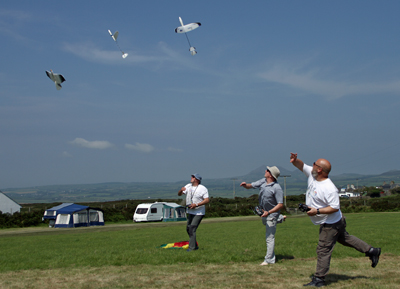
PSSA fun with the DLG models in the calm conditions (Dave Gilder photo)
On Sunday the winds were from the SW first thing but very light, 4-6mph max, the forecast showed this swinging through W and settling in the afternoon at NW – which dictated us parking on the NW slope at Cilan. As the day mapped out, the light winds never did swing round, and by mid afternoon we had walked with some light models from the NW car park round the back of Anne’s farm and beyond the trig point to the SW slope. The winds were only 5-7mph here but the air was so warm and again thermals were in play. The few pilots on site successfully flew light sports models at this idyllic site.
I attempted to fly the JP again but again just a few slope passes were possible before I was forced to land cross slope – there just wasn’t quite enough blow. It was all very frustrating – all we needed was a bit more energy and we would have been well set! Other modellers camping on Cilan and seeing our lack of progress from their tents stayed put on the site and enjoyed an afternoons DLG and electric flying from the campsite. All good fun and great that we always make the most of any conditions we find ourselves with.
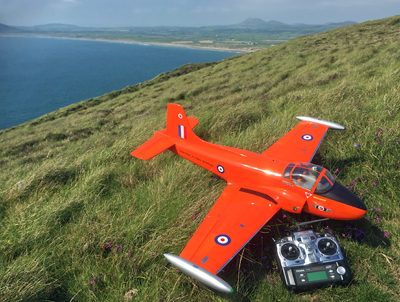
My JP sat awaiting a bit more wind on Cilan…
So a frustrating weekend from a PSS flying perspective, such a shame to be on the Lleyn in glorious sunny conditions but not have the favourable winds to suit our needs!
A big thanks to all who travelled, and a special thanks to both Austin Massey and Brian Gowland from the Lleyn MAC who helped with organisational support both before and during the weekend! We look forward to returning next year on a weekend with higher wind speeds!!